RANTS FROM THE MOUNTAIN: THE THIN VENEER OF CIVILIZATION
“Civilization is but a thin veneer stretched across the passions of the human heart. And civilization doesn't just happen; we have to make it happen.”
— Bill Moyers
There are a myriad of reasons why my wife and I ultimately decided to leave Europe and return to Guatemala, and, more specifically, why we decided to pour our resources and time into transitioning to an off-grid life. One of the main reasons was the growing realization that the modern world—the very same one we grew up in during the 1990s and early 2000s—was becoming increasingly unsustainable, with uncertainty compounding.
Year after year, month after month, we watched the cracks widen. The certainty we once took for granted slowly gave way to instability. Changes so radical and unforeseen that they would once have seemed unthinkable became commonplace. We took them as warning shots and decided it was time to invest in something more resilient: self-sustainability, endurance, and legacy building.
So, on any given Tuesday, like clockwork:
The front gate at the condominio where we currently live before moving permanently to the homestead has been having problems with its electric motor. It fails, breaks down, gets repaired after three days, works briefly, then fails again. Over and over and over again. It is a Sisyphean task without explanation. It shouldn’t be that hard, and yet it is.
Every time a water pipe in town cracks, leaks, or bursts, the Muni cuts off water to the entire town for three to five days. No remedy, no explanation, no long-term solution. We will just wait and see when it bursts again and then figure it out. And this happens far too often. It shouldn’t be that hard, and yet it is.
I call customer service and a woman answers the phone. I know she is a real human being—I can discern that much from her voice—but beyond that, she might as well be a chatbot. An AI bot in human flesh, incapable of understanding my request or deviating from the script to find a solution. Eventually, I simply let it go and keep trucking. That's all you can do. No solution will ever be found without sacrificing five hours of your life to phone menus, internet outages, status updates, transfers, and endless discussions about terms and conditions. It shouldn’t be that hard, and yet it is.
Nor is this uniquely Guatemalan.
My most recent experience at Madrid Airport was so chaotic and needlessly exhausting that I found myself wondering whether this was the same Europe I had known years ago, where systems seemed to function almost effortlessly, propelled forward almost by magic and inertia alone. In Sweden, my friend was advised to wait many months to see a specialist about her thyroid cancer. I’ve felt more nervous walking down a Paris street at night than I do in my small village in Guatemala. At least here I can carry a firearm almost everywhere for self-defense; over there, kitchen knives are illegal. Developed world once meant developed systems. I'm no longer convinced that is true. The wear and tear of what once ran smoothly has now aged to the degree of operational failure.
By now I see this decline almost everywhere.
The woman at the bank has no idea how to perform routine tasks. It's as though we're speaking different languages. A professional with a five-year university degree demonstrates the critical thinking and analytical skills I would expect from a young teenager with below-average grades. Do they just hand out diplomas for being able to spell your own name these days? Bureaucrats embody institutional incompetence. They don’t even try to hide it anymore. They can’t be bothered with excellence or pride in their work, just the 9-to-5 underwhelming sense of duty.
A twenty-ton truck swerves recklessly through traffic, completely devoid of the universe of probabilistic outcomes and consequences. Corporations poison our food without correction, accountability, or self-awareness. Politicians pile on debt and taxes while making productive life steadily harder. The current polycrisis unfolds with almost no evidence that anyone is capable of responding to it. Internet service somehow performs worse than it did in 2019.
Flock-like security cameras installed on the street, violating our right to privacy, multiply across public spaces, contracted by unknown companies, paid for by unknown budgets, operated under unknown oversight. The aimlessness of the vast majority of the population, glued to a screen whilst crossing a packed freeway with the situational awareness of a pile of bricks. The blank and empty stare of those whose job it is to solve problems, there because of salary and certainly not conviction, but who are in reality strangers to the reality you experience, sworn enemies to efficiency, competency, and creativity. Then there was the collective insanity of the COVID pandemic. No answers from leaders, no questions to the pharmaceutical industrial complex, no trials for criminals, no charges for those who profited from the lies told, no justice for those victimized by the response.
Trust slowly disappears from every cog in the machine. Faith in institutions gives way to resignation. An abandoned raft drifting in a vast sea of abject carelessness and incomprehensible complexity that defies logic at every turn, Kafka’s nightmare come to life.
Modern life depends upon countless interconnected systems functioning simultaneously, and increasingly it feels as though they are all beginning to fail—not through spectacular collapse, but through a thousand small acts of incompetence. One dumb and menial reason at a time.
I keep the names and phone numbers of the very few people I have found over the years without whom I could never get anything done. Transportation experts, hard workers, efficient plumbers, master carpenters, methodical builders, creative thinkers, capable professionals. They are worth their weight in gold. They are exceptions that prove the rule.
Civilizations are not sustained by institutions. They are sustained by competent people.
I watched this movie, The Big Short, about the 2009 GFC. That one financial meltdown—no one knows where it came from. So many subprimes were layered over leveraged and compromised titles, rates, derivatives, shares, and fintech products that the actual crack could never be chased down, never resolved.
When our current infrastructure finally snaps, much of the same will happen. There will not be one single main reason. A cascade of hidden failures, each individually insignificant, collectively overwhelming. Infinite in number and too deeply buried for history to uncover. Things just simultaneously cease to work and to be.
And then, of course, is the malicious intent behind the ruptures, wars, breakdown, and failures. A topic best left untouched for now.
But why?
I posit a number of reasons:
Systems have become too complex for any individual to fully understand.
Bureaucracies have expanded to the point where they increasingly consume the productive economy instead of supporting it.
Failure of an antiquated and obsolete industrial educational system that is less capable of producing independent, competent problem-solvers.
The philosophy of obsolescence.
The eradication of a common system of societal values that once enshrined excellence, honor, and duty, and have now become ghost terms of a bygone era.
Dysgenic pressure at the population level—that is gradually reducing the pool of exceptional individuals required to sustain civilizations of ever-increasing complexity.
Globalization that makes us dependent on a constant and well lubricated supply chain of endless parts that come from halfway across the world.
What happens when all of this finally fails?
My prediction is that our civilization has become too complex to repair once critical systems begin failing. Fewer and fewer people truly understand how anything works, and therefore fewer people are capable of putting it back together once the little blinking lights begin to turn red. Too many variables. Too much automation. Too many incentives pointing in the wrong direction, leaving us only watching it slowly rot, or actively dismantling it. We have become remarkably good at building complexity. Far less capable of maintaining it.
That is one of the reasons we chose to go off-grid.
We began with Maslow's hierarchy of needs. It has taken years, but I finally feel as though we are beginning to understand what it actually takes to sustain life independently—not just for ourselves, but potentially for multiple families.
To some degree, a refuge of simplicity, a paradise of strategic redundancies, an oasis of autonomy at a small scale.
Shelter: We are currently building an 80 m² house around a simple question: How inexpensively can we build a beautiful, durable, well-constructed home? Once construction is complete, I intend to publish every expense and every lesson learned.
Food: How much food can one cuerda of land realistically produce? We'll find out after the coming harvest.
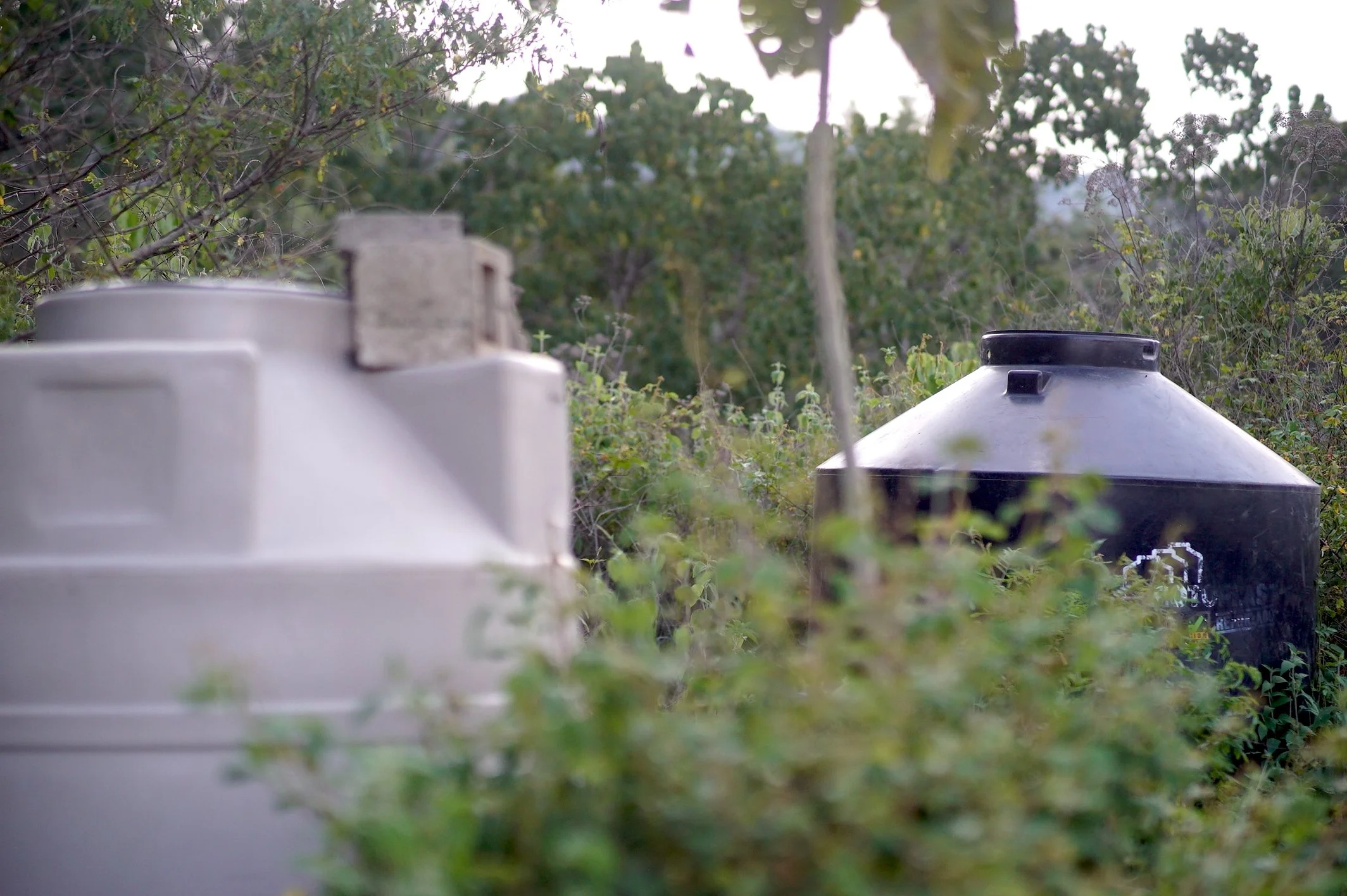
Water: How much water does a family actually need, and how much can be harvested from rainfall? We currently have a 4 m³ household cistern that overflows into an additional 8 m³ of storage. Soon we will complete an 88 m³ underground cistern designed for long-term water security.
Security: We have developed a layered homestead security system that is continually being refined and improved. An article on how we managed security up there coming soon as well.
What I do know is that we don’t have much time, but it is beyond my foresight and control how much is left. So there is a running clock that makes us race forward; we just can’t tell how much we have got left.
Whatever happens, I am grateful we started two years ago.